Choosing a day clock for someone living with dementia
What a calendar clock does that a phone or a wall clock cannot, where to put it, how bright it should be at night, and what it will not fix.
The question that keeps returning
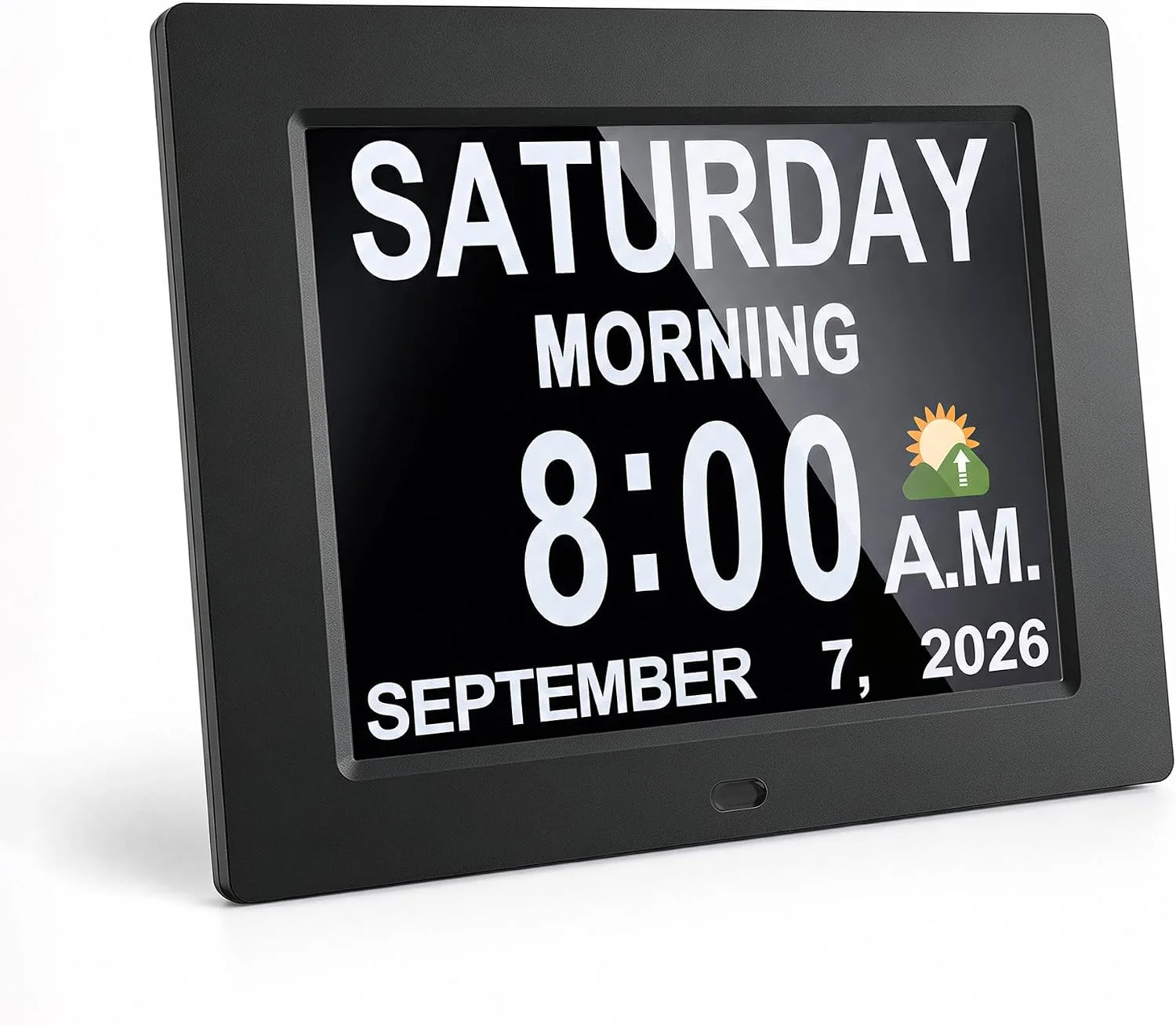
The loop can begin early in the morning. Your parent might ask what day of the week it is. You answer clearly. A few minutes later, the question comes back. By the afternoon, you may have answered the same question a dozen times. This repetition is not an attempt to be difficult. It comes from a deep need for security. When memory begins to fade, the natural anchors of time slip away. The person feels a constant, quiet sense of being lost. They ask the question because they are trying to find their footing in the week.
An ordinary clock does not always provide the answer they need. A traditional wall clock with hands requires a complex mental calculation. The brain must look at the shapes, identify the numbers, and translate the angles of the hands into a specific hour and minute. For someone living with cognitive change, this translation can become too difficult. They might look at the hands and see only a confusing pattern.
Smartphones and tablets present their own challenges. A phone screen is often small. It requires the person to press a button, swipe the screen, or enter a code to see the date. If they manage to wake the screen, they are confronted with a crowded display. They might see text messages, missed calls, battery levels, and small notifications. The actual date is usually written in tiny font at the very top. This wealth of information is overwhelming. It distracts from the simple answer they were seeking. If they accidentally swipe the wrong way, they may open an app they cannot close, leading to frustration.
A day clock answers the constant question before it has to be asked, preserving a quiet sense of control.
A dedicated calendar clock addresses this need directly. It does not require any interaction. It does not send alerts or show battery symbols. It sits in a fixed place, showing the essential details in large, clear letters. The person does not have to search for the information or perform mental translations. They can simply look up and find the anchor they are looking for.
The language of complete words
When we are busy, we rely on shortcuts. We glance at a calendar and quickly process abbreviations like "Tue" or "Nov" without a second thought. Our minds instantly fill in the missing letters. For someone living with dementia, these shortcuts can become roadblocks. The letters are seen, but the shortcut no longer connects to the day it stands for.
An abbreviation like "Wed" can look like a spelling mistake. It might look like a foreign word or a random collection of letters. The person may spend several minutes trying to decode what "Wed" means, which only increases their confusion. The abbreviation does not trigger the mental image of Wednesday. It does not bring the comfort of knowing where they are in the weekly cycle.
Spelling the words out in full removes this cognitive hurdle. A word like "Wednesday" or "September" has a familiar, reassuring visual shape. Your parent has seen these complete words thousands of times over their lifetime, and a long-familiar word is often easier to read than a code.
Our calendar day clocks are designed with this principle in mind. They spell out the day of the week, the month, and the date in full, with no abbreviations. The typeface is clean, bold, and easy to read. There are no stylized fonts or decorative elements to distort the letters. By presenting the information in its most complete and natural form, the clock helps the person read the display without having to guess or translate. It provides a direct, uncomplicated path to the answer they need.
| What the clock shows | Why it is written in full | What to check before buying |
|---|---|---|
| Day of the week | “Wed” is a code; “Wednesday” is a word a person can read without decoding | The full word, in type you can read from the doorway |
| Month and date | Numbers alone (08/15) ask the reader to remember the order | Month spelled out, date beside it |
| Time of day | Twelve-hour time without a period of day leaves 6:00 ambiguous | A clear AM/PM, or a period-of-day word |
| Alarms and reminders | Medication and appointments need a prompt, not a memory | Up to 12 alarms and hourly reminders on our calendar models |
The blocks of the day
For most of our lives, we live by the minute. We plan meetings for 10:15, catch trains at 5:40, and monitor the seconds as they tick by. As cognitive change progresses, this precise relationship with time often shifts. The exact minute becomes much less important than the general phase of the day.
A person living with dementia may wake up from a nap at six o'clock. If they look at a standard clock that only shows "6:00," they may not know if it is six in the morning or six in the evening. This confusion can lead to high anxiety. They might start getting dressed for the day in the middle of winter twilight, or they might worry that they have missed breakfast when it is actually time for dinner. The numbers alone do not give them enough context to understand their environment.
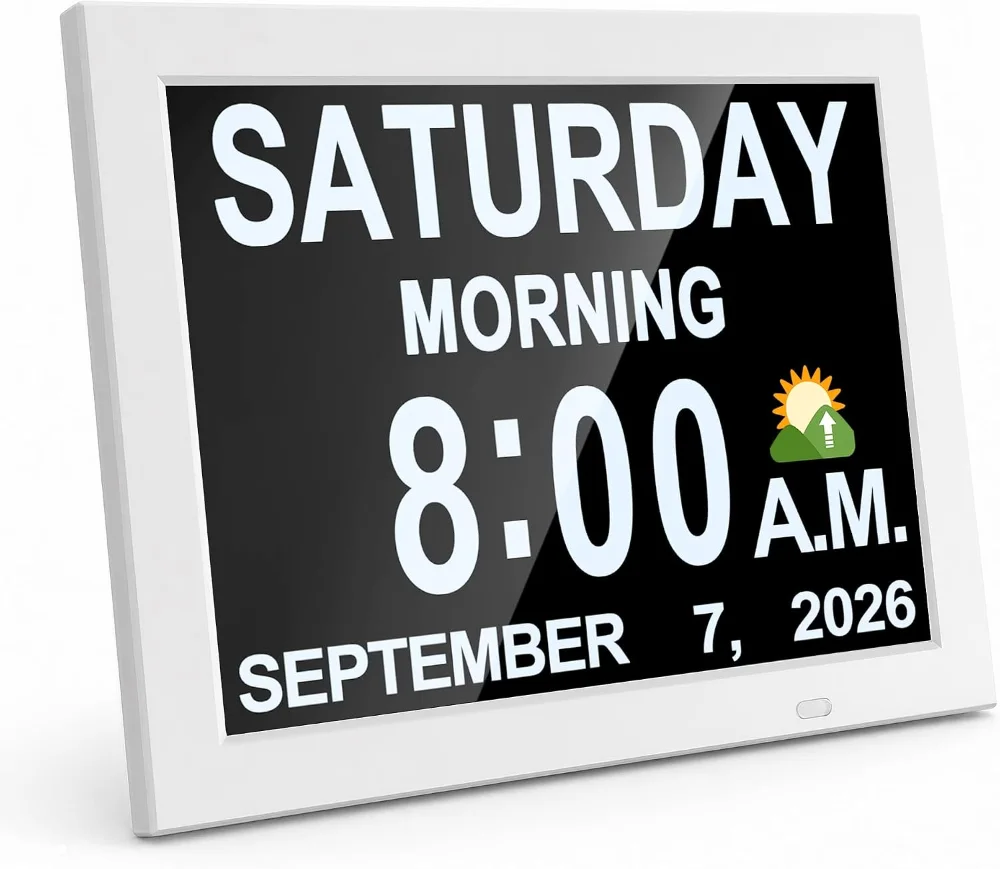
Dividing the day into clear blocks helps resolve this confusion. Knowing that it is "Morning," "Afternoon," "Evening," or "Night" provides an immediate frame of reference. It tells the person what they should expect from their surroundings. If the clock says "Morning," they know it is time to start the day. If it says "Evening," they understand that the day is winding down and it will soon be time for bed.
This broad division of time matches the natural rhythm of a caregiving routine. It helps reinforce the structure of the day without the pressure of precise scheduling. The time is still there on the screen for you to reference, but the large text describing the part of the day is what provides the emotional reassurance. It helps your parent feel aligned with the world around them, reducing the feeling of being untethered in time.
Finding the right place and size
A day clock must be easy to see. Consider the daily path of the person you care for. Identify where they sit most often and where they look when they first wake up.
A clock should be positioned directly in their line of sight. If your parent spends hours in a specific armchair, place the clock on a wall or a shelf directly opposite that chair, at eye height when they are seated. If they have to turn their head at an awkward angle, they may ignore the clock. In the bedroom, the clock should be visible from the pillow, so they can see it the moment they open their eyes.
At JALL, we offer calendar day clocks with display sizes of 7, 8, 10, and 12 inches. A large 12-inch screen is excellent for a spacious living room where the digits must be read from across the room. An 8-inch or 10-inch screen fits well on a kitchen counter. For a bedside table, a smaller model is more appropriate. We have a compact bedside model that shows the day and date alongside a temperature readout, which fits easily next to a lamp.
Avoid placing the clock near windows where direct sunlight can create a harsh glare. Glare can wash out the letters, making them invisible to aging eyes.
Our clocks run on mains power, ensuring the display remains bright. Battery-powered digital displays often grow dim as the cells drain, making the screen hard to read. Because these clocks run on electricity, make sure the power cord is tucked safely behind furniture to prevent tripping. If there is a power cut, you do not have to worry about resetting the time. The settings survive because of an internal memory backup. When the power returns, the clock displays the correct time immediately.
| Where it goes | Why | What to avoid |
|---|---|---|
| Facing the bed, at eye height from the pillow | The first question on waking is “what day is it” | Sideways to the bed, where reading it means sitting up |
| By the chair they sit in most | Orientation is needed all day, not only in the morning | Behind them, or on a shelf above the eye line |
| Away from a window | Glare washes out any display | Direct sun on the screen in the afternoon |
| On mains power | A clock that stops is worse than no clock | A spot with no outlet, a cord across a walkway |
Brightness and the evening environment
The light levels in a home have a powerful effect on sleep and behavior. Managing these levels is a key part of creating a calm environment. The National Institute on Aging explains that people with Alzheimer's disease may experience changes in their sleep patterns. They may sleep a lot during the day, wake up many times at night, or become restless and confused as daylight begins to fade, a pattern often called sundowning.
To help ease this transition into evening, the National Institute on Aging recommends keeping the evening quiet and peaceful. This includes keeping the lights low and avoiding exposure to electronic screens. A bright, glowing screen in a dark room reads to the body like daytime.
A day clock should not double as a nightlight. While nightlights are incredibly useful for safety, they belong in hallways, bathrooms, and walkways to prevent falls. The bedroom itself should remain dark and quiet to encourage deep rest. If a clock screen is too bright at night, it can cast a harsh glow across the bed, disturbing your parent's sleep.
The display on our clocks can be dimmed to a very low level during the night. This ensures that the letters are still readable if your parent wakes up, but the screen does not throw excess light into the room. It maintains the dark, peaceful atmosphere that is necessary for a good night of rest, helping to support a natural sleep cycle.
Using alarms and reminders with care
The calendar models in our range feature up to 12 alarms and optional hourly reminders. These tools can be very helpful for organizing a daily routine, but they must be used with a clear understanding of your parent's daily life.
Alarms can be used to prompt important tasks, such as taking a specific medication, drinking a glass of water, or getting ready for a regular visitor. Some models allow you to set reminders for specific times of day, which can help maintain structure. However, it is easy to overload a clock with too many alerts.
If an alarm sounds and your parent is home alone, they may not remember what the sound means. A sudden buzzer or chime can cause a startle response, leading to anxiety rather than action. They might wander around the house trying to find the source of the noise, or they might feel frustrated because they cannot figure out how to turn it off.
Because of this, we recommend setting only the alarms that you know will be answered. If you or a professional caregiver are present to assist with medication, you probably do not need the clock to sound an alarm for it. The clock should support your caregiving, not replace your presence.
If you do decide to use alarms, start slowly. Set just one reminder for a consistent, daily event, such as an afternoon snack. Observe if they look at the clock and understand what to do. If they find the sound distressing, it is best to turn the alarm off and rely on other ways to prompt them. The goal is always to reduce tension in the home, not to add new sources of noise.
Understanding the limits of a clock
When you are searching for tools to help a loved one with dementia, it is easy to hope that a single product will solve a wide range of difficulties. It is important to be realistic about what a day clock can and cannot do.
A day clock is an environmental aid. It is a simple tool designed to present information in an accessible way. It does not treat, slow, or diagnose any medical condition. It cannot improve memory, reverse cognitive decline, or cure the underlying causes of dementia.
If your parent is experiencing significant sleep disturbances, wandering during the night, or severe agitation during the evening, a clock will not resolve these challenges. These behaviors are complex symptoms of cognitive change. They require careful management and professional advice.
The National Institute on Aging notes that a medical condition or a medication may be the cause of sleep problems, and that if the problems continue, the person to talk to is a healthcare provider. A doctor can review your parent's medications, check for physical causes of discomfort, and offer safe, clinical strategies to help them rest.
The National Institute on Aging provides several recommendations for managing sleep challenges. These include daily exercise and limiting naps late in the day. They also suggest planning energetic activities early in the day. In the evening, keeping a quiet routine with low lights and no electronic screens helps prepare the body for rest. Maintaining a regular schedule for sleep and waking, even on weekends, is also helpful. Finally, avoiding alcohol and caffeine can make a significant difference. If these sleep problems continue, it is best to consult a healthcare provider.
A day clock can support a structured routine, but it is just one small part of a larger care plan. It works best when combined with a consistent daily schedule and regular medical oversight. Use the clock for what it does best: providing clear, quiet information to help your parent feel more oriented during their waking hours.
Day clocks in our range
Calendar models spell out the day and the month; the bedside model shows the day and date in a smaller case with a temperature readout.

Supporting the caregiver's sleep
When you are looking after a parent, it is easy to put your own needs last. You may focus entirely on their comfort, their schedule, and their health, while neglecting your own well-being. This is a common path to caregiver burnout. Your health is directly connected to your ability to provide care, and sleep is the foundation of that health.
The Centers for Disease Control and Prevention lists a consistent sleep and wake time first among habits that improve sleep. This advice is critical for caregivers. When your parent's sleep is disrupted, your sleep is often disrupted too. If they wake up confused in the middle of the night, you are the one who must rise to comfort them and help them back to bed. Over time, this fragmented sleep can lead to chronic exhaustion.
At JALL, we design our clocks to help bring a sense of order to the household. By providing your parent with a clear, reliable source of time and date information, you may find that their nighttime anxiety decreases. If they wake up at 3:00 AM and can see at a glance that it is still night, they may be more likely to settle back to sleep on their own, rather than calling out or getting out of bed.
To support your own rest, try to establish a regular sleep schedule for yourself. Go to bed and wake up at the same time every day, even on weekends. Create a quiet wind-down routine in the evening, away from screens and work. If your parent's sleep challenges continue to disrupt your nights, do not hesitate to discuss this with their doctor. Managing caregiver fatigue is a vital part of managing the person's overall care.
Introducing the clock without a fuss
People living with cognitive change can be sensitive to changes in their environment. Introducing a new object, even a helpful one, can sometimes cause resistance if it is handled with too much emphasis.
If you present the clock as a special tool to help with their memory, your parent may feel defensive. They might see it as an admission of their decline, which can hurt their pride and make them reject the clock entirely. They might insist they do not need it, or they might refuse to look at it.
The most successful approach is usually the quietest one. Simply set up the clock in its designated spot when they are in another room or when they are asleep. Plug it in, set the correct time, and let it start working without any announcement.
If they notice it and ask about it, keep your answer casual and brief. You might say, "I wanted a clock with larger numbers for this room so it is easier to read from the chair," or "I thought this spot needed a nice, clear clock." This frames the purchase as a simple home improvement rather than a medical intervention. It removes the pressure and allows them to accept the clock on their own terms.
Within a few days, they will likely start using the clock naturally. They will look at it to confirm the day before they ask, and you may notice the frequency of their questions begin to drop. By introducing the clock without ceremony, you allow it to become a natural, comforting part of their daily landscape.
Preserving dignity
Living with dementia brings many small losses. It can be deeply unsettling to realize that you no longer know what month it is, or whether it is morning or afternoon. Forgetting these basic facts can make a person feel vulnerable and out of control.
When your parent asks you what day it is for the tenth time in an afternoon, they are not trying to test your patience. They are seeking a safe harbor in a world that has become confusing. Answering them with a sigh or a sharp tone can chip away at their self-esteem. It can make them feel like a burden.
A day clock serves as a silent, patient helper. It does not get tired of answering. It does not sigh, and it does not show frustration when the day has been forgotten again. It simply stands in the room, displaying the day, the month, and the time in steady, clear letters.
By placing a clear clock in their living space, you are offering them a way to find the answer on their own, without having to ask. This small bit of independence is valuable. It helps preserve their dignity and allows them to feel more secure in their own home. It is a quiet way of showing respect for their experience, helping them move through each day with a little more ease.
This article is general information for families and caregivers. It is not medical advice and does not diagnose or treat any condition. A clock is an aid to orientation, not a treatment; the care plan belongs with the person’s healthcare provider.